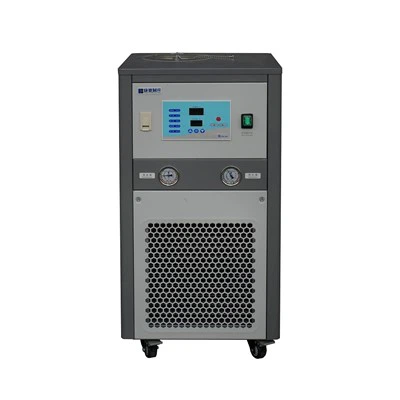

Chillers are indispensable temperature control equipment in modern industry and commerce, playing a crucial role in ensuring stable production processes and improving energy efficiency.Their basic principle is to transfer heat from the target space or medium to the external environment through a refrigeration cycle system, thereby achieving precise cooling. Based on different working principles and structural forms, common types include compression chillers, absorption chillers, and evaporative chillers, among which compression chillers are widely used due to their high efficiency and adaptability.
In terms of composition, a chiller mainly consists of four core components working together: a compressor, a condenser, an expansion valve, and an evaporator. The compressor drives the refrigerant circulation and increases its pressure and temperature; the condenser cools and condenses the high-temperature, high-pressure gaseous refrigerant into a liquid state, releasing heat to the cooling medium; the expansion valve reduces the pressure and temperature of the refrigerant through throttling, allowing it to enter the evaporator to absorb heat and evaporate, thus removing heat from the object being cooled; the evaporator is connected to the cooled circuit to complete the heat exchange process. This closed-loop cycle ensures continuous and stable cooling capacity and can be dynamically adjusted according to load changes.
In industrial applications, chillers provide reliable temperature control support for processes such as plastics processing, chemical reactions, electronics manufacturing, pharmaceutical production, and food processing. For example, in the operation of high-precision machine tools, stable cooling can prevent thermal deformation from interfering with processing accuracy; in laser equipment or semiconductor production lines, chillers ensure that critical components operate in a constant temperature environment, extending their lifespan and maintaining performance consistency. In the commercial sector, such as large supermarkets, data centers, and medical imaging centers, chillers also rely on them to handle the heat load generated by dense personnel or high-power equipment operation, creating a comfortable environment and ensuring system safety.
With the deepening of energy conservation and emission reduction concepts, chiller technology is continuously advancing towards higher efficiency and intelligence. New environmentally friendly refrigerants replace traditional working fluids, reducing the greenhouse effect potential; variable frequency drives and intelligent control algorithms enable on-demand cooling, reducing ineffective energy consumption; the introduction of heat recovery systems can convert waste heat into usable heat sources, expanding the dimensions of energy utilization. These advancements not only meet the requirements of green manufacturing but also bring significant operating cost optimization to users.
As a crucial support for the process chain and environmental control, the selection of chillers requires comprehensive consideration of cooling capacity requirements, operating conditions, energy efficiency indicators, and ease of maintenance. By appropriately matching equipment capacity and control strategies, performance can be guaranteed while avoiding resource waste caused by over-configuration. In the future, with the integration of IoT and big data technologies, chillers will demonstrate greater value in remote monitoring, predictive maintenance, and energy efficiency management, continuously driving the industry's operational quality towards refinement and sustainability.