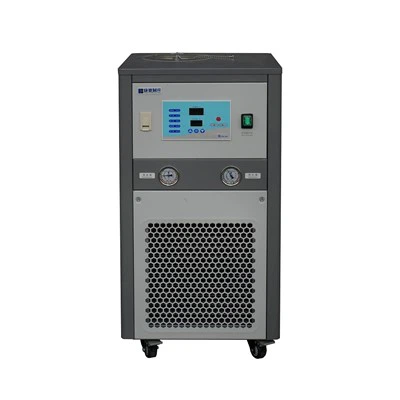

As a key device for achieving precise temperature control, chillers can be classified in various ways based on their working principles, structural forms, and energy utilization methods in different application scenarios. Understanding the characteristics of each type helps to achieve an optimal balance between performance and cost in selection and application.
Based on the driving energy and working principle, the most common type is the compression chiller. This type of equipment relies on a mechanical compressor to increase the refrigerant pressure and temperature, and completes heat transfer through condensation, throttling, and evaporation processes. It has the advantages of fast cooling speed, high efficiency, and a wide cooling capacity range, and is widely used in industrial production and commercial buildings. Absorption chillers use thermal energy as the main driving force, utilizing lithium bromide solution to absorb and release water vapor to achieve cooling. They are suitable for occasions with stable heat sources such as waste heat, exhaust heat, or gas, and can perform effectively in environments with limited electricity or requiring comprehensive energy utilization. Evaporative cooling chillers rely on the natural evaporation of water and air to remove heat. They have a relatively simple structure and low energy consumption, but their cooling capacity is greatly affected by ambient humidity, and they are mostly used for auxiliary cooling in arid climates.
From the perspective of cooling method, chillers can also be divided into water-cooled and air-cooled types. Water-cooled systems use circulating water to remove heat from the refrigerant in the condenser, resulting in high heat exchange efficiency and low operating noise. They are suitable for applications with concentrated space, abundant water supply, and easy access to cooling towers. Air-cooled systems use fans to drive airflow through the condenser for heat dissipation, eliminating the need for a cooling water system. They offer flexible installation, smaller footprint, and are often used in scenarios where water supply is limited or frequent relocation is required. However, their cooling performance may decrease at high temperatures.
Based on structural form and cooling capacity, systems can also be categorized as integrated or split-type. Integrated systems integrate the compressor, condenser, evaporator, and control system into a single casing, resulting in a compact structure and easy mobility, suitable for small laboratories, medical equipment, or localized process cooling. Split-type systems separate the main heat exchange components, allowing for connections via longer piping. This facilitates flexible configuration in large factories or space-constrained environments, balancing cooling capacity with site adaptability. Furthermore, based on operating temperature range, they can be further subdivided into general-purpose, medium-low temperature, and cryogenic types to meet diverse needs, from conventional process cooling to the cryogenic preservation of special materials.
With increasing demands for energy conservation and environmental protection, the classification of chillers is also reflected in new technological approaches, such as magnetic levitation centrifugal chillers, variable frequency screw chillers, and natural refrigerant chillers. These exhibit unique advantages in part-load energy efficiency, vibration control, and greenhouse gas emission reduction. Clearly defining the performance boundaries and applicable environments of different categories can provide users with a scientific basis during the solution planning stage, enabling chiller systems to achieve the best balance between reliability, economy, and sustainability.