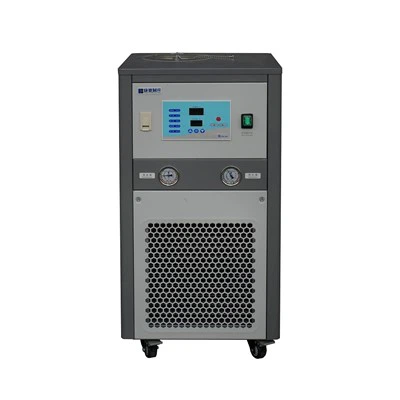

In the semiconductor industry chain, temperature stability and accuracy directly affect chip yield, process consistency, and equipment lifespan. Semiconductor chillers, as precision temperature control equipment specifically designed for this industry, provide indispensable cooling for core processes such as wafer fabrication, photolithography, etching, thin film deposition, and packaging testing, thanks to their ultra-low temperature, high precision, and high reliability. They are a crucial foundation for the advancement of advanced processes.
Semiconductor manufacturing processes are extremely sensitive to temperature. For example, in photolithography, even minute temperature drifts in the lens and mask stage can cause projected image displacement, severely affecting linewidth accuracy. Reaction chambers in etching and chemical vapor deposition (CVD) require strict temperature control of the cooling medium to avoid film thickness unevenness or increased defects caused by reaction rate fluctuations. Ion implantation and physical vapor deposition (PVD) equipment rely on chillers to remove the heat generated by high-energy beams, maintaining process window stability. Therefore, semiconductor chillers must not only provide large cooling capacity but also achieve dynamic temperature control within ±0.1℃ or even higher precision and be able to quickly respond to sudden load changes.
In terms of design principles, semiconductor chillers emphasize "ultra-stability" and "cleanliness." The refrigeration system primarily employs a combination of cascade or cryogenic screw/centrifugal compressors, achieving a wide cooling capacity output from -40℃ to ambient temperature to meet the differentiated needs of various process stages. Heat exchangers utilize high-efficiency, corrosion-resistant materials and optimized flow channel structures to reduce pressure drop and increase heat exchange rates. The circulation pipeline features a fully enclosed design with electrolytic polishing or passivation treatment of the inner walls, combined with online filtration and sterilization modules to prevent particulate or microbial contamination of the cleanroom environment. Refrigerant selection balances environmental friendliness and thermal performance; some models have switched to low GWP solutions, aligning with international emission reduction trends.

Intelligent control is another core advantage. The unit is equipped with multiple high-precision temperature sensors and adaptive algorithms, enabling real-time monitoring and correction of temperature deviations. Combined with process equipment load signals, predictive adjustments are made to reduce energy waste caused by overcooling or overheating. Simultaneously, the system integrates remote monitoring and fault diagnosis functions, facilitating unattended operation and rapid maintenance in cleanrooms or explosion-proof environments.
Safety redundancy design ensures continuous production. Key components such as compressors, circulating pumps, and power modules often employ N+1 or redundancy configurations, and are equipped with multiple protection interlocks for flow, pressure, and temperature. In the event of an anomaly, automatic switching or shutdown is initiated to prevent damage to expensive process equipment.
As semiconductor processes advance towards greater detail and higher integration, the requirements for temperature control accuracy, response speed, and cleanliness levels of chillers continue to increase. Semiconductor chillers, with their more advanced refrigeration technologies, more intelligent control systems, and more reliable system architectures, are building a solid temperature control foundation for the stable and efficient operation of chip manufacturing.