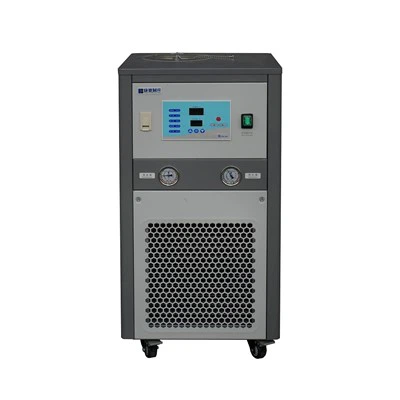

An oil cooler is a device specifically designed for controlling the temperature of lubricating oil or other process oils. It plays a crucial role in stabilizing oil temperature and ensuring equipment performance in industrial production and machinery operation.Through a scientific refrigeration and heat exchange process, it removes excess heat generated in the oil due to friction, shearing, or external heat sources, maintaining the oil viscosity, lubrication performance, and equipment operating parameters within a reasonable range. This extends equipment life, improves operating efficiency, and reduces the risk of failure.
The core working principle of an oil cooler is similar to that of a chiller, based on a refrigeration cycle of compression, condensation, throttling, and evaporation. The compressor compresses the low-temperature, low-pressure refrigerant gas into a high-temperature, high-pressure state, which then enters the condenser to exchange heat with water or air, releasing heat and condensing into a liquid state. The liquid refrigerant, after being throttled and depressurized by the expansion valve, enters the evaporator, where it absorbs heat from the oil flowing through it under low pressure and evaporates, causing the oil temperature to drop. The evaporated gaseous refrigerant returns to the compressor to continue the cycle. This closed-loop operation achieves continuous cooling and temperature stability of the oil. Because heat exchange between oil and refrigerant must overcome differences in viscosity and heat transfer characteristics, oil chillers prioritize oil corrosion resistance and efficient heat transfer in their evaporator structure and material selection to ensure consistent performance under various operating conditions.
In application areas, oil chillers are widely used in metal processing, machinery manufacturing, hydraulic systems, and power equipment industries. The spindle and guideway lubrication systems of CNC machine tools, machining centers, and grinding machines require stable oil temperatures to prevent viscosity decreases, oil film rupture, and deterioration of machining accuracy due to excessively high temperatures. Oil chillers provide precise temperature control, ensuring cutting and forming quality. During prolonged high-load operation of hydraulic equipment, elevated hydraulic oil temperatures can cause system pressure fluctuations and seal aging. Timely heat dissipation by oil chillers maintains hydraulic circuit stability, reducing leaks and maintenance frequency. In the lubrication circuits of gearboxes, reducers, and large motor bearings, oil chillers effectively suppress oil temperature rise, preventing mechanical wear and overheating failures caused by poor lubrication. Heat generated during the operation of equipment such as power transformers and converters can also be dissipated through oil chillers, ensuring stable insulating oil performance and electrical parameters.
Oil chillers emphasize temperature control accuracy and response speed in terms of performance. Modern models are often equipped with variable frequency compressors and intelligent temperature control systems, which can automatically adjust the cooling capacity according to changes in oil temperature, achieving high-precision control within ±0.5℃ and quickly responding to load fluctuations, reducing temperature overshoot and hysteresis. In terms of structural design, some models employ independent circulating oil circuits and multiple filtration devices to prevent impurities in the oil from affecting heat exchange efficiency and equipment lifespan; others combine air-cooled or water-cooled condensers to flexibly adapt to different installation environments and cooling conditions. For safety protection, features include oil temperature over-limit alarms, insufficient flow protection, and anti-freeze functions to ensure timely shutdown or switching of operating modes under abnormal conditions, reducing the risk of equipment damage.
With increasing demands for energy conservation and environmental protection, oil chillers are continuously improving in terms of energy efficiency and environmental friendliness. The application of new high-efficiency heat exchangers and refrigerants with low global warming potential reduces energy consumption per unit cooling capacity and minimizes environmental impact. Some models incorporate heat recovery devices to utilize waste heat from the refrigeration process for workshop heating or process preheating, achieving secondary energy utilization. The widespread adoption of intelligent monitoring and remote diagnostics allows users to monitor equipment status in real time and perform predictive maintenance, further optimizing operation and maintenance costs and reliability.
Oil coolers, with their targeted oil temperature control capabilities, stable heat exchange performance, and wide applicability, have become crucial equipment for ensuring the efficient and safe operation of mechanical and process systems, playing an irreplaceable role in improving product quality and reducing operational risks.