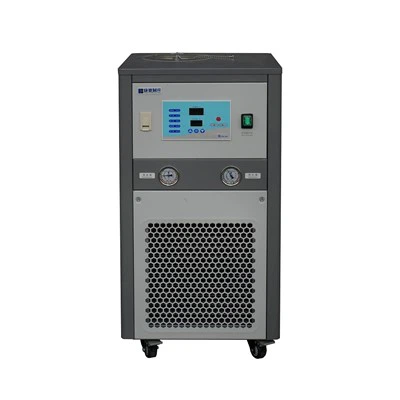

In modern machining, heat is one of the most common reasons behind unstable production.
As spindle speed increases and machining time becomes longer, the temperature of the cutting fluid also rises. Once this happens, the impact is not limited to the coolant itself. It can directly affect machining accuracy, tool life, surface finish, and batch consistency.
That is why more manufacturers are paying attention to the role of an immersion cutting fluid cooler.

Rising Coolant Temperature Means Rising Production Risk
In many workshops, the problem does not appear all at once. At the beginning of production, the machine may run normally. But after continuous operation, coolant temperature gradually increases, and the effects start to show:
- dimensional accuracy becomes less stable
- thermal expansion affects part consistency
- cutting tools wear faster
- surface finish becomes uneven
- scrap and rework rates increase
For factories producing precision metal parts, these problems can quickly become hidden production costs.

What an Immersion Cutting Fluid Cooler Does
An immersion cutting fluid cooler is designed to remove heat directly from the coolant tank or coolant circulation system.
Its function is not simply to make the fluid colder. More importantly, it helps the coolant stay within a stable operating temperature range, so the machining process itself stays more stable.
With proper coolant temperature control, manufacturers can achieve:
- better dimensional stability
- improved machining precision
- longer tool service life
- more consistent surface quality
- more reliable continuous operation
This makes immersion cutting fluid coolers especially suitable for CNC machining centers, milling machines, grinding machines, drilling equipment, and other precision machining applications.

Why KANSA Is a Reliable Choice
KANSA has long specialized in industrial refrigeration equipment and provides a full range of solutions including industrial chillers, cutting fluid coolers, oil coolers, low-temperature chillers, and high-precision chillers. According to the product catalogue, KANSA also has a strong R&D team, advanced production lines, and dedicated testing capability, which gives customers greater confidence in both quality and customization.
For immersion cutting fluid cooling applications, this matters because customers usually need more than a standard machine. They need a system that matches their actual working conditions, including:
- machine heat load
- coolant tank size
- target temperature
- precision requirement
- installation space
- operating environment
KANSA's manufacturing and technical strengths make this possible.

Technical Advantages That Matter in Real Use
The catalogue highlights a number of product and manufacturing strengths that are especially valuable for cutting fluid cooling applications, including:
- high-precision temperature control, with options up to ±0.1°C
- standard precision options of ±0.5°C and ±1.5°C
- low-temperature solutions down to -5°C, -15°C, and -35°C
- SU304 shell-and-tube evaporators
- efficient condenser design and silent fan configuration
- well-known compressor and component brands such as Copeland, Panasonic, Hitachi, Danfoss, Emerson, and Schneider Electric
These are not just technical details. For the customer, they translate into more stable operation, better cooling efficiency, and longer equipment life.

More Than Cooling, It Supports Better Machining Results
A good immersion cutting fluid cooler helps solve several production issues at the same time.
It reduces heat accumulation in the coolant, stabilizes the machining environment, and helps the machine maintain more repeatable performance over long operating hours.
In practical terms, that means:
- fewer dimensional deviations
- lower thermal drift
- less tool damage caused by excess heat
- better consistency between shifts and batches
- a more reliable production process overall
For workshops focused on quality and efficiency, this is where the real value lies.
KANSA's Strength in Customization
One of the strongest messages throughout the catalogue is KANSA's ability to provide professionally designed and customized solutions. The company combines in-house manufacturing, testing resources, and engineering support to respond to different industrial applications.
This is especially important for immersion cutting fluid cooling, because no two machining lines are exactly the same. A suitable cooling solution often depends on the real process rather than on a generic model selection alone.

Conclusion
An immersion cutting fluid cooler is not just an accessory for a machine. It is an important tool for improving machining stability, dimensional accuracy, tool life, and overall production consistency.
With its strong R&D capability, advanced manufacturing facilities, testing center, precision control options, and customization experience, KANSA is well positioned to provide reliable cooling solutions for precision machining applications.
For manufacturers facing overheating coolant, unstable accuracy, or rising tool wear, a KANSA immersion cutting fluid cooler can be a practical step toward better quality and more efficient production.